
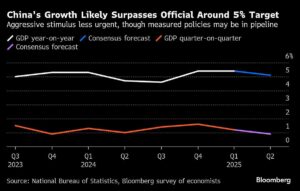
(July 14): China’s economy likely expanded just above the government’s full-year growth target in the second quarter, easing pressure on Beijing to roll out additional stimulus in the near term.
Official figures due Tuesday are expected to show gross domestic product rose 5.1% year-on-year in the quarter ended June, according to a Bloomberg survey. While slower than the first quarter, it would still put first-half growth at 5.3%, comfortably above Beijing’s annual target of around 5%, the survey shows.
The economy got a boost from strong exports, helped by a trade truce with the US in mid-May that lowered tariffs on Chinese goods to around 55% from a peak of 145%, as well as ongoing fiscal support aimed at shoring up domestic demand.
That momentum has many economists expecting Beijing to hold off on further stimulus, at least for now, to preserve policy space in case tensions with Washington flare up again once the temporary deal expires in mid-August.
 “We see limited urgency for policymakers to strike the policy put soon,” Citigroup Inc economists including Xiangrong Yu wrote in a note Thursday.
Data released on Monday showed exports rising 5.8% in June, accelerating for the first time since March and beating economists’ expectations.
An upcoming July meeting of the Communist Party’s Politburo, which includes 24 of the country’s most senior officials led by President Xi Jinping, could “further confirm a wait-and-see policy mode, while keeping the door open for incremental small-scale support,” the Citi economists said.
The People’s Bank of China has indicated it’s taking a less dovish stance on easing. In a statement after its quarterly monetary policy committee meeting last month, the central bank dropped its earlier pledge to cut interest rates and inject long-term liquidity in a timely manner, saying instead it would “calibrate the intensity and pace of policy implementation” with flexibility.
The central bank will closely monitor the impact of measures already implemented and pace the roll-out of further policies, Zou Lan, a deputy governor of the PBOC, said on Monday.
That said, the boost from front-loading of exports and earlier fiscal support may fade in the second half, potentially increasing the need for more policy action later this year. Economists from Citi and Nomura Holdings Inc expect a 10-basis-point cut to the policy rate and a 50-basis-point reduction in banks’ reserve requirement ratios by year-end.
Here’s a preview of other key economic indicators set for release by the National Bureau of Statistics at 10am Beijing time Tuesday.
Consumption
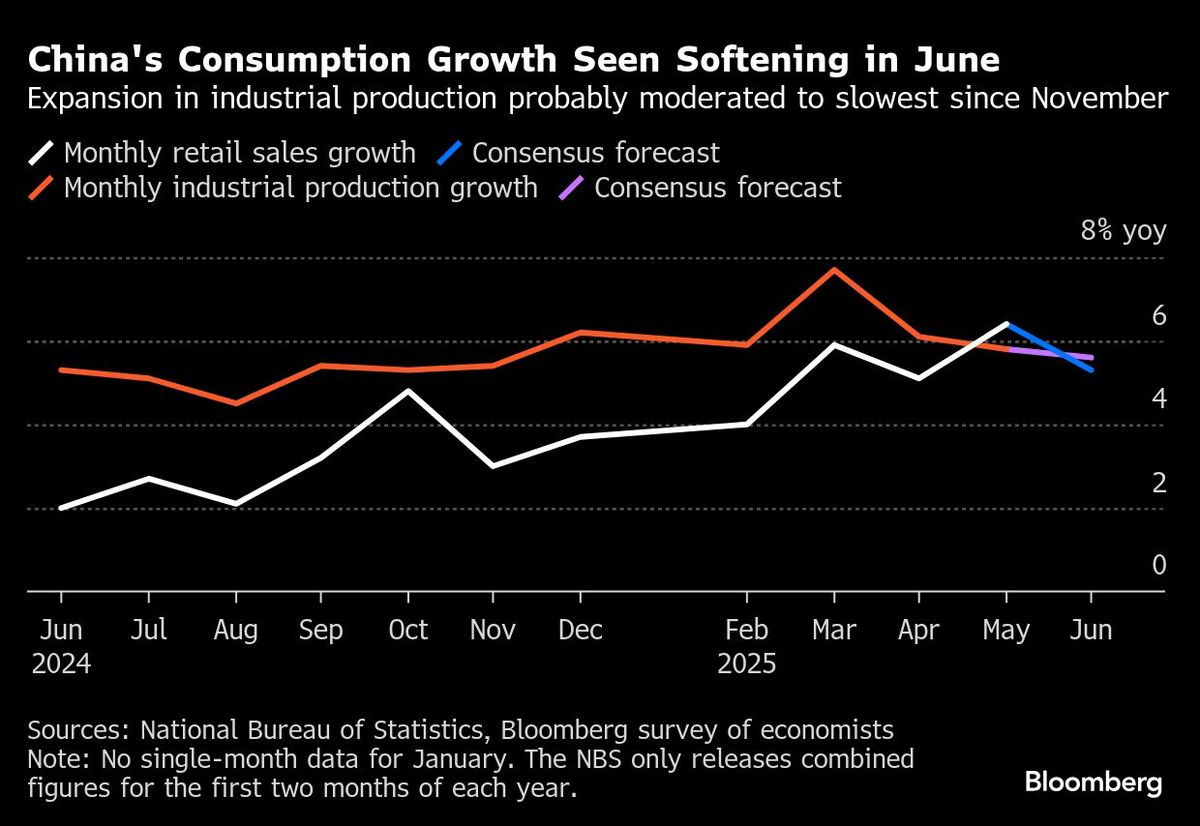
Retail sales growth is expected to have slowed to 5.3% in June year-on-year from 6.4% in May, bringing first-half expansion to around 5%.
Sales might have taken a hit in June as some provinces suspended government subsidies for consumer purchases of items like smartphones, home appliances and cars. The early launch of JD.com’s mid-year shopping festival in mid-May — weeks earlier than last year — could have pulled spending forward, weighing on last month’s figures.
 China earmarked 300 billion yuan (US$41.8 billion or RM177.9 billion) from the issuance of ultra-long special sovereign bonds to fund consumer subsidies this year. Officials said more than half the funds were deployed in the first half, with the remainder to be allocated in July and October. Weekly spending plans will be made with an aim to keep subsidies available to consumers through year-end.
The threat of higher US tariffs on Chinese goods in the coming months has prompted some economists to urge Beijing to roll out more consumer-focused support to cushion the blow to growth. Academics including PBOC adviser Huang Yiping said authorities should add as much as 1.5 trillion yuan in new stimulus over 12 months to help offset the potential impact of US levies.
The government is planning to offer nationwide childcare subsidies, which is also part of broader efforts to boost birth rates, Bloomberg previously reported.
“The subsidies of 3,600 yuan (US$503) per birth a year are likely too modest to stem a decline in new births, but can be useful in boosting sentiment and consumption. And we continue to hold the view that the program should be expanded to all children to spur spending — as the economy badly needs to revive domestic demand to counter a deteriorating external environment,” said Bloomberg Economics.
Industry, anti-involution
Industrial production probably rose 5.6% in June, the slowest pace since November, according to the survey. Things could improve in the coming months after new orders returned to growth in June following two straight months of contraction, thanks to the tariff truce.
Still, humming production lines don’t always translate into stronger earnings. Excess capacity continues to drive a supply glut, weighing on prices. Profits at China’s industrial firms fell 1.1% in the first five months despite rising output, underscoring deflationary pressures and the need to tackle overcapacity.
At a high-level meeting earlier this month, leaders vowed to curb “involution,” or cutthroat competition among firms, raising hopes that Beijing is stepping up efforts to end the years-long price wars dragging on growth.
“The renewed focus on anti-involution is a step in the right direction,” Morgan Stanley economists including Robin Xing wrote in a Thursday report.
They cautioned that progress would likely be slower than a similar campaign a decade ago, given the “fundamentally more difficult” industrial and macroeconomic backdrop. The bank sees deflation persisting into next year.
Investment
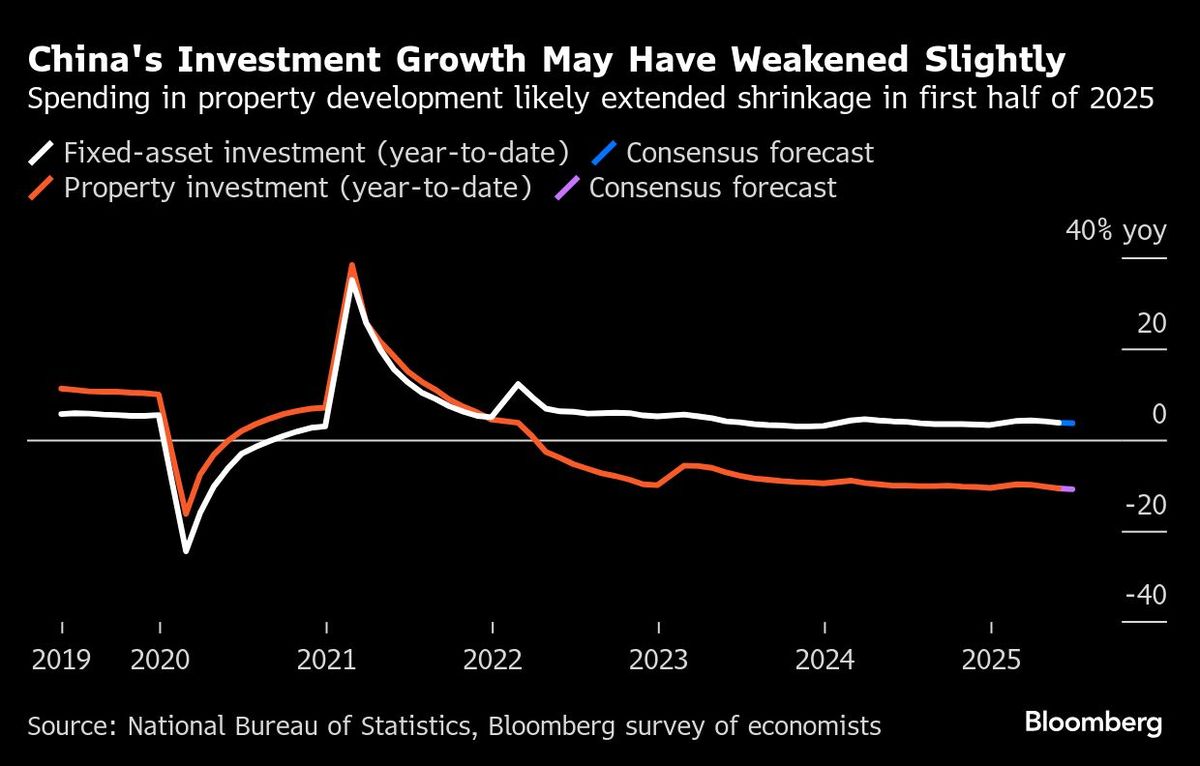
Fixed-asset investment is expected to have risen 3.6% year-on-year in the first six months, slightly weaker than the pace over January to May. The property market contraction likely continued, with real estate investment estimated to have tumbled 10.9%, marking a new low since the start of the pandemic.
Speculation is growing that a high-level government meeting could be held this week to shore up the struggling property sector, fuelling a rally in Chinese developer stocks.
 The government has been front-loading fiscal aid already planned this year to give the economy an early boost. In the second half, the central government has a total 745 billion yuan of ultra-long special sovereign bonds to sell and provinces still have more than two trillion yuan in annual special bond quota available, according to earlier reports by state media.
Beijing also has room to do more. The Citi economists said authorities could revive the Pledged Supplementary Lending facility or other related policy financing tools, potentially delivering up to 500 billion yuan in quasi-fiscal stimulus by the end of December.
While China’s growth may have held up in the first half, Nomura economists including Lu Ting warned of a looming “demand cliff” over the rest of the year, driven by factors such as the reining in of industrial overcapacity, weaker export momentum and continued real estate troubles.
“Beijing needs to take bolder actions to clean up the mess in the property sector, support consumption in a more sustainable way by reforming the pension system, fix the fiscal system to better protect business owners and improve its relationships with other economies,” they wrote in a recent note.