


KUALA LUMPUR (July 17): Malaysia will likely miss its fiscal deficit reduction target as government expenditure may, yet again, exceed its budget while revenue may undershoot expectations, according to BMI.
The budget gap, as a proportion of economic output, will narrow only marginally to 4.0% in 2025, wider than the projected 3.8% for the year, from 4.1% in 2024, said the independent research arm of Fitch Solutions. That will delay Malaysia’s medium-term goal to shrink the deficit to 3.0% by 2028.
“Subdued economic activity will keep a lid on tax collection,” BMI said and cautioned that the government’s assumption for oil prices per barrel to trade between US$75 (RM318.52) and US$80 in 2025 “will probably prove too optimistic”.
Malaysia’s economic growth has decelerated for three straight quarters, coming in at 4.4% year-on-year for the first three months of 2025. Malaysian policymakers have also said they may revise its initial growth forecast of 4.5%-5.5% on US tariff risks.
Oil prices, meanwhile, have softened from US$75 at the end of 2024, averaging US$69.90 per barrel in the first six months of 2025 amid global demand concerns. Malaysia relies on petroleum receipts for a huge chunk of government revenue.
“We suspect policymakers will overshoot planned expenditure in 2025, as they have consistently done so in recent years,” BMI flagged.
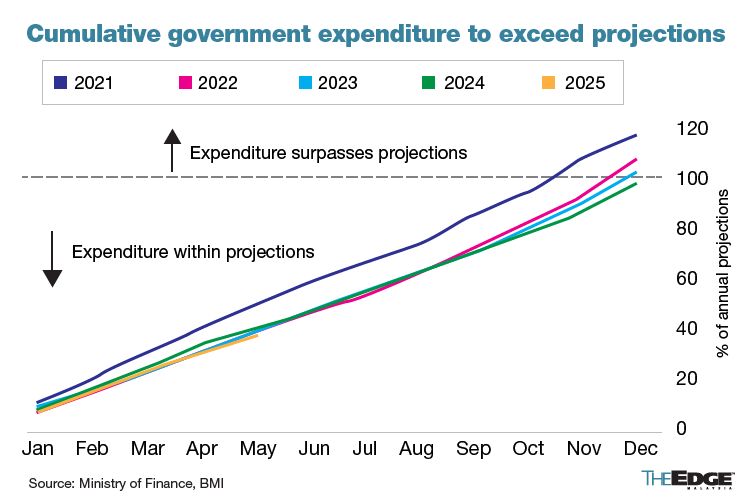
Further, details remain scant for the RON95 subsidy rationalisation, a key area for expenditure reduction, and the increase in electricity tariffs could weigh on public coffers, the research house warned.
“While the adjustment will probably not affect most households,” BMI said, “Malaysia’s cost pass-through system will probably add pressure on the government to further subsidise utility costs” beyond the RM6.0 billion allocated in the first half of 2025.
Any cuts to subsidies would help to lower the government’s operating expenditure currently financed by revenue. Under Malaysia’s fiscal rules, any government borrowings to cover the budget shortfall are only to finance development expenditure.
“Ultimately, we expect public debt to continue rising in the coming years,” BMI said. “We believe that the silver lining is that given that more than 97% of total debt were ringgit-denominated securities, currency-mismatch risks are minimal.”
Source: The Edge